
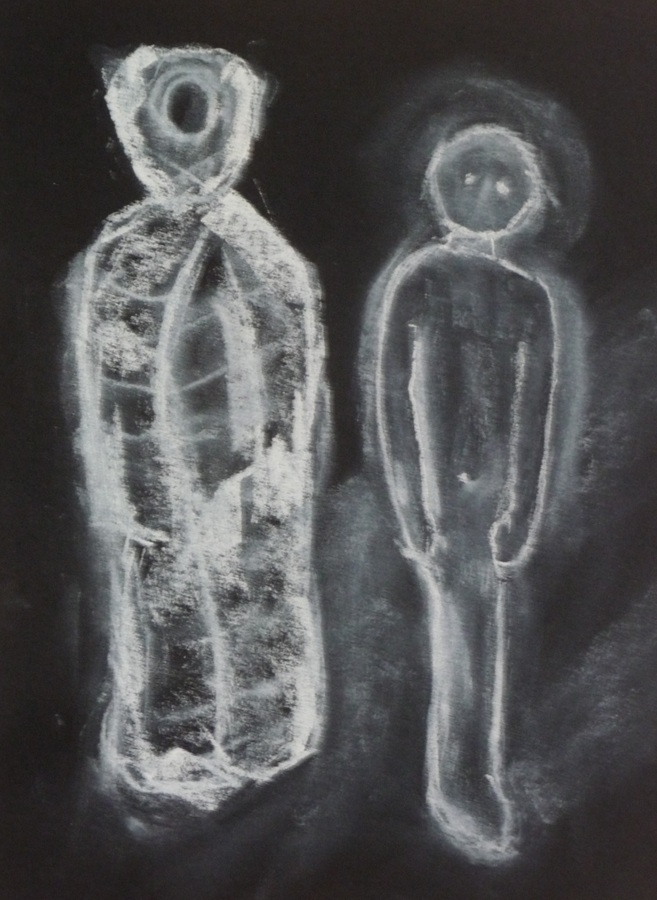
This remembrance has two significant parts beginning on a weekend art retreat at St Beuno’s that led on to a midweek IGR during which was Remembrance Day.
On the weekend of 6-8th November 2009, I shared in an art retreat led by Renate, ever sensitive, even timid in her helpful hesitancy, as she led and facilitated our exploring. The weekend retreat was called ‘Looking with the Eye of Art: Breathing spaces beyond words’. It wasn’t silent, rather a conversation out of reflective engagement with art and each other’s awareness. The key was a climate of listening prayerfully. And so it proved to be. But the Sunday was Remembrance Sunday and the two minutes silence was honoured at 11am.
Then came a most memorable remembrance. Renate, though German, shared from her experience as a young girl. Her father, captured in the German assault on Russia, returned from a Siberian concentration camp in 1947, and she recalled how he would take Renate with him to where he loved to stand in a shaft of light in the woods and feel his freedom. She spoke too, of a Bavarian religious sister who shared her similar story. She remembered her father leaving in uniform to fight in the war in 1941. He returned in 1949, eight years later and four years after the war had ended. He loved to stand in his fields and feel free, and never spoke of his suffering, but lived gratefully, simply, farming the land and keeping livestock, making baskets from willow in the evening, faithfully going in church, and attending mass.
After the weekend finished, I stayed on for a midweek individually guided art retreat accompanied by Renate. She invited me to explore being with Lazarus and his emerging from his tomb, called out by Jesus. I had been aware of my own creative constrictions, struggles, tensions, and stuckness. So Renate suggested exploring with clay instead of facing a blank and threatening, white sheet of cartridge paper. I explored with the tactile clay, feeling its weight, the struggle to make a figure stand, aware of its fragility, an echo of humanly being a clay pot, yet malleable, mouldable, able to change, perhaps a hollow man, experiencing a deadness, an emptiness, a nothingness. I didn’t give my bound Lazarus a face. Instead he had a hooded head, empty, like the rest of his clay body, still wrapped in death’s effects, yet just waking, slowly trying to move and walk.
There was the emptiness of death’s power in the presence of Jesus; the emptiness of all that deadens and constricts life in the face of Jesus’ call to live again, and the feelings of old mental tapes that do not tell the whole truth and were just empty, imprisoning claims.
I was reminded of the power that is made perfect in weakness, how befriending one’s lack and trusting in Jesus, gives God space to fill the nothingness and emptiness. I was aware that Lazarus was Jesus’ friend for whom he wept: “See how he loved him!” (John 11:16); that Jesus befriends the whole of us, and shows this especially to the least, the lost, the lacking, the sick and the dying. And how Jesus cries out in love, in loss, to give new life calling to me by name, “Come out”.
I wondered later, in the night, about the dead waking, the helplessness of Lazarus who couldn’t raise himself and needed helpers to unbind him. The grave clothes had ‘swaddled’ him, like a child, helpless, ‘locked’ inside. I reflected on the encasing clay hollow man, and thought of the inner man breaking or escaping out like leaving a shell of grave clothes. So once up in the morning, a complementary and vulnerable inner, just freed, clay figure took shape.
After sharing all this with Renate, she suggested that I might draw these clay “sculptures” using chalk to express my thoughts and feelings further, but using my left, my least dominant hand. And so emerge the images than accompany this testimony to God’s grace and Renate’s guidance. Then, as I prayed with these drawings, a meditative poem took shape which afterwards I surrounded with the colours of light and warmth. Finally I dated it: 11:11:2009. Another, personally significant, Remembrance Day.
Standing now;
no longer laid,
wrapped, inert,
lost to all but one
who wept as well.
Summoned now;
to life and air,
light and sound,
to open eyes
on love’s eternal gaze.
Silent now,
head tilted,
quizzical, questioning;
even arms and hands attentive
in anticipation.
Suspended now;
naked in new creation,
hollowed chest
yet to take full breath,
waiting…
‘On Lazarus’ by Graham Pigott